
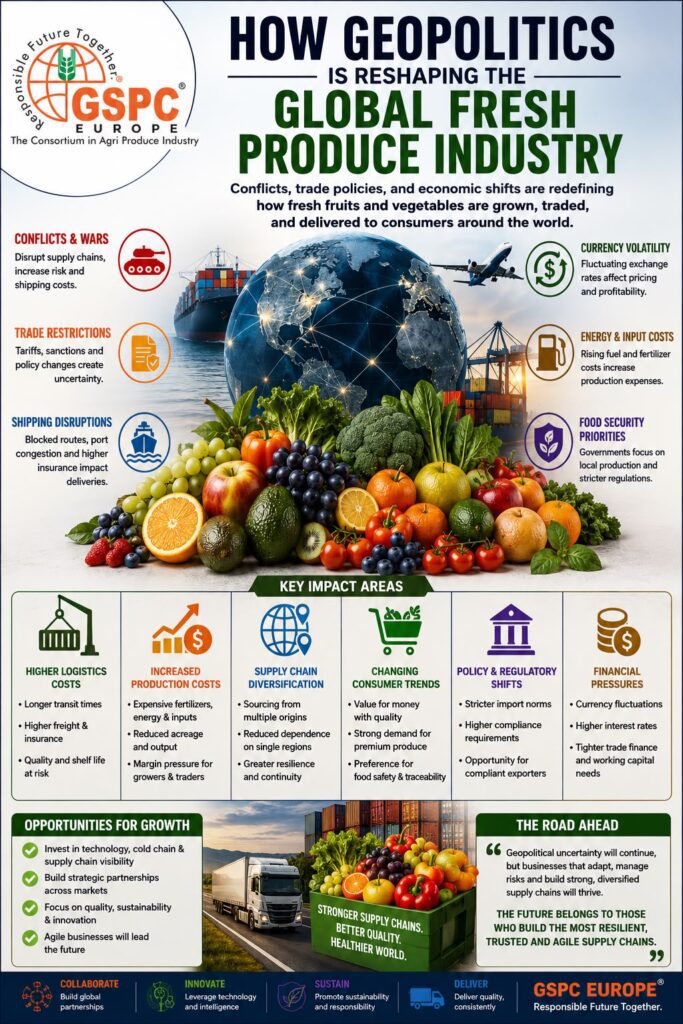
The global fresh produce industry has always been influenced by weather, seasonality, and consumer demand. Today, however, a new force has become equally significant—geopolitics. Armed conflicts, trade disputes, sanctions, shipping disruptions, currency volatility, and changing government policies are redefining how fruits and vegetables are grown, traded, transported, and consumed worldwide.
For growers, exporters, importers, retailers, and logistics providers, understanding geopolitical risks is no longer optional. It has become a critical factor in business strategy and long-term sustainability.
The New Reality of Global Trade
Over the past few years, geopolitical tensions have transformed international trade. Conflicts in key regions, disruptions to major shipping lanes, and shifting alliances have created uncertainty across global supply chains.
Unlike manufactured goods, fresh produce is highly perishable. Even a delay of a few days can significantly reduce quality, shorten shelf life, and lower market value. As a result, geopolitical events have a more immediate and visible impact on the fresh produce industry than on many other sectors.
Rising Logistics Costs
Shipping has become one of the biggest challenges facing the industry.
Diversions around conflict zones, higher marine insurance premiums, fluctuating fuel prices, and congestion at major ports have increased transportation costs substantially. Longer transit times also increase the risk of quality deterioration, particularly for products such as grapes, berries, citrus, avocados, and stone fruits.
Importers are therefore placing greater emphasis on reliable logistics, efficient cold-chain management, and flexible sourcing strategies.
Inflation and Higher Production Costs
Geopolitical instability often affects energy markets, leading to higher fuel and electricity prices. Since fertilizers are energy-intensive to manufacture, rising energy costs quickly translate into higher agricultural input costs.
Growers around the world are facing increased expenses for fertilizers, irrigation, packaging materials, labor, and transportation. Many are reducing planted acreage or limiting input usage to control costs, potentially affecting future production volumes.
Supply Chain Diversification
One of the most significant trends emerging from recent geopolitical developments is the diversification of sourcing.
Instead of relying on a single country or region, importers are building supply programs across multiple origins. Apples may be sourced from Turkey, Poland, Italy, or South Africa. Citrus programs may combine Egypt, South Africa, Spain, and Australia. Similar diversification is occurring across grapes, kiwifruit, avocados, and berries.
This strategy reduces dependence on any single market and improves resilience against disruptions.
Changing Consumer Markets
Inflation has influenced purchasing behaviour worldwide.
Consumers are becoming more price conscious while continuing to prioritize quality, food safety, and freshness. Premium fruit still enjoys strong demand, particularly in developed economies and affluent urban markets, although purchasing decisions have become more selective.
Retailers are also seeking greater consistency in supply, leading to stronger partnerships with reliable exporters.
Trade Policies and Food Security
Many governments now view food security as a strategic priority.
Countries are investing in domestic agriculture, encouraging local production, reviewing import regulations, and strengthening phytosanitary standards. While these measures enhance national food security, they also create additional compliance requirements for exporters.
Companies that maintain high standards of traceability, food safety, and regulatory compliance are increasingly gaining a competitive advantage.
Financial Pressures
The financial environment has become more challenging.
Currency fluctuations, higher interest rates, rising insurance costs, and cautious trade financing have increased working capital requirements for importers and exporters alike. Businesses with strong balance sheets, disciplined cash-flow management, and diversified customer bases are better positioned to withstand market volatility.
Opportunities Amid Uncertainty
Despite these challenges, the fresh produce industry continues to offer significant opportunities.
Global demand for healthy food continues to grow. Consumers increasingly recognize the nutritional benefits of fresh fruits and vegetables, supporting long-term demand across developed and emerging markets.
Companies that invest in technology, digital supply-chain visibility, artificial intelligence, cold-chain infrastructure, sustainability, and diversified sourcing are likely to emerge stronger.
Innovation in quality monitoring, predictive demand forecasting, and logistics optimization will become key differentiators in an increasingly competitive marketplace.
Outlook
Geopolitical uncertainty is expected to remain a defining feature of international trade over the coming years. While risks will persist, businesses that adapt quickly, manage supply-chain risks effectively, and build strategic partnerships across multiple origins will be well positioned for sustainable growth.
The future of the global fresh produce industry will belong not only to those who produce the best fruit, but also to those who build the most resilient, agile, and trusted supply chains.
Author: Pradip Kumar Nath
Director – GSPC Global | Globoblitz Fresh Ideas
Global Fresh Produce & Supply Chain Strategist