
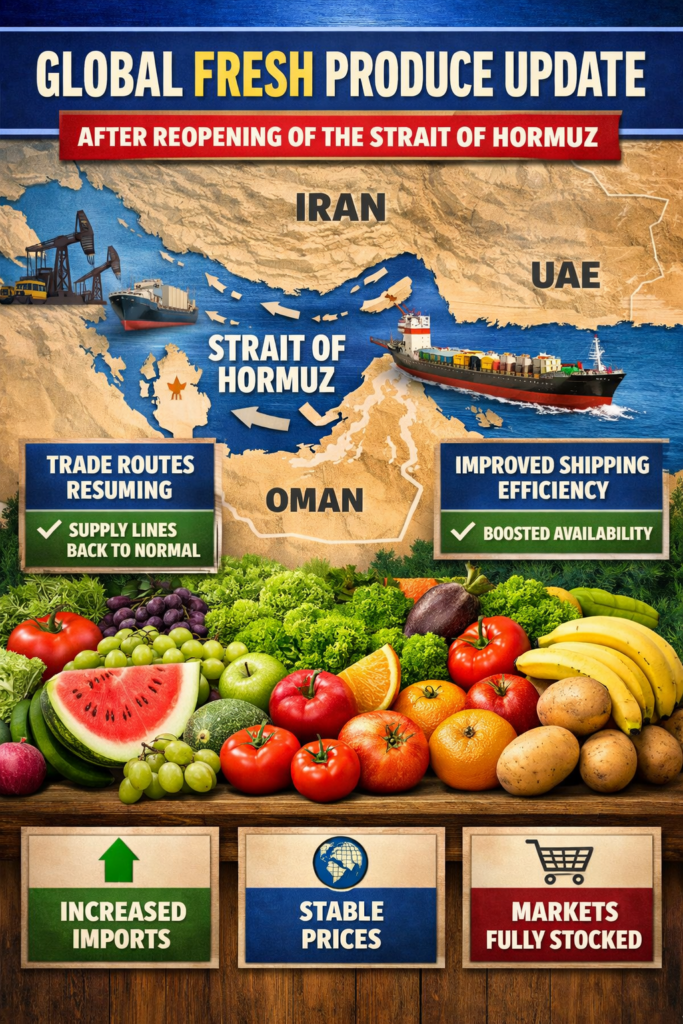
The reopening of the Strait of Hormuz to commercial traffic—while currently a delicate “ceasefire” scenario—would be the single most critical catalyst for stabilizing the global fresh fruit trade. We can look at this through two lenses: the immediate operational “unclogging” and the broader economic cooling effect.
## 1. Operational “Unclogging”: The Logistics Pivot
When the Strait reopens, the transition from “survival mode” back to “efficiency mode” happens in three waves:
* **Immediate Relief of the “Perishability Trap”:** Currently, millions of dollars in fruit (like Indian grapes/banana or South African apple pears) are either sitting in congested “safe ports” or enduring long truck hauls across the desert. Reopening allows vessels to resume direct calls to Jebel Ali and Dammam. This cuts transit times by **7–12 days**, which is the difference between “fresh” and “food waste” for high-respiration fruits.
* **Reefer Container Velocity:** The “equipment crunch” eases. When ships don’t have to sail around the Cape of Good Hope, containers return to the global pool faster. This increases the “container turn rate,” lower vessel idling costs, and eventually brings down the record-high freight rates we’ve seen this month.
* **The Land-Bridge Wind-Down:** The emergency land-bridge services (trucking from Oman/Saudi to the Gulf) are expensive and cause bruising to delicate fruit. A return to sea routes means less handling, fewer temperature fluctuations, and better quality upon arrival at retail.
## 2. Commercial Impact on Food Inflation
The reopening acts as a “pressure release valve” for global food prices, though the effects are not instantaneous.
### The “Cooling” Effect:
* **Elimination of Surcharges:** War-risk insurance premiums and “Emergency Risk Surcharges” (currently **$3,000–$5,000 per container**) would be the first costs to vanish. This allows wholesalers to lower their “landed cost” and pass some savings to the consumer.
* **The Fertilizer Connection:** This is the “hidden” inflation driver. The Strait of Hormuz carries roughly **33% of the world’s traded fertilizer**. Reopening the Strait ensures that nitrogen and phosphate exports from the Gulf reach global farmers. This lowers the cost of the *next* harvest, preventing a second wave of inflation in late 2026.
* **Energy Costs:** With oil prices stabilizing from their **$120/barrel** peak, the cost of running refrigeration (which is energy-intensive) drops, further easing the retail price of chilled goods.
### The Reality Check:
While the logistics improve, **”Price Hysteresis”** often occurs—prices go up quickly but come down slowly. Retailers may keep prices elevated for a few months to recoup the massive losses sustained during the March blockade.
## 3. Summary
**Key Takeaway:** The reopening doesn’t just move fruit; it restores the global “cold chain” integrity. While logistics will bounce back within weeks, the commercial impact on inflation will likely take **3 to 6 months** to fully reach the grocery store shelf.