
The global fresh fruit market in February 2026 is seeing a mix of stabilization in staple commodities and premium pricing in the surging tropical and organic sectors. Overall, while the World Bank projects a modest 2% decline in broad agricultural prices for 2026, the fresh fruit sector is behaving differently due to specific climate and logistical pressures.
1. General Market Outlook
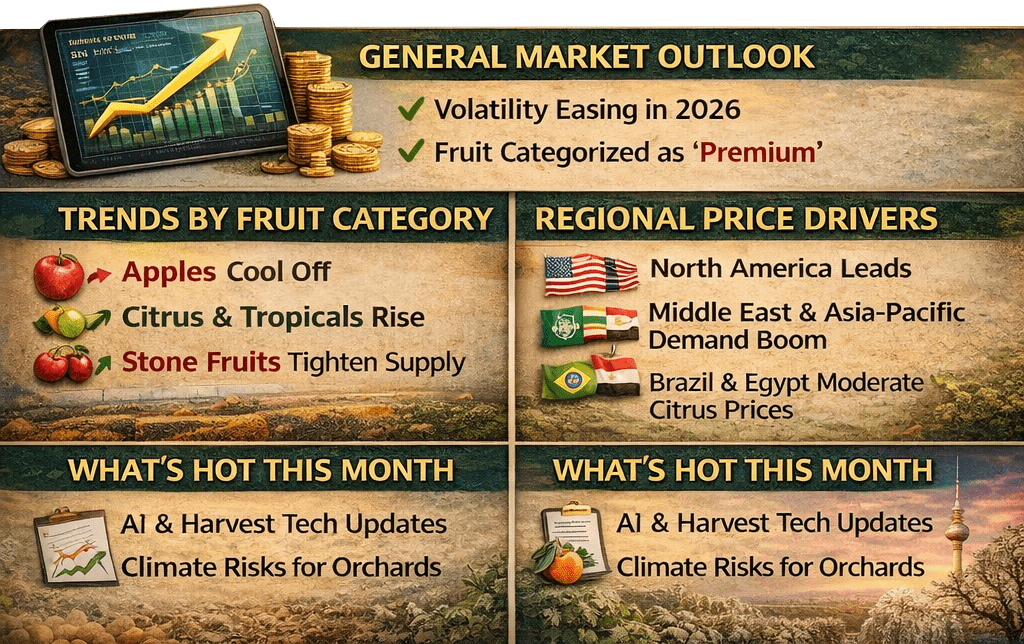
- Broad Price Index: The Producer Price Index (PPI) for fresh fruits and melons showed significant volatility at the end of 2025, but it has stabilized in early 2026.
- Inflationary Pressures: While food inflation is cooling in some regions, fresh fruit remains a “premium” category. In the EU, the price index for fruit reached 151 points late last year, though a heavy apple harvest has recently provided some downward pressure.
2. Trends by Fruit Category
| Category | Price Trend | Key Driver |
|---|---|---|
|
Apples |
📉 Decreasing |
Large harvests in Europe and North America have created an ample supply, weakening prices from late 2025 into early 2026. |
|
Citrus |
📈 Increasing |
Florida’s orange forecast is down 2%, and adverse weather in the Mediterranean has limited the supply of lemons and limes. |
|
Tropicals |
📈 Increasing |
Dragon fruit, avocados, and passion fruit are seeing high demand. The dragon fruit market alone is valued at $4.1 billion this year. |
|
Bananas |
↔️ Stable |
As the world’s most traded fruit, supply remains steady, though logistics costs in the Middle East and Panama are keeping prices firm. |
|
Stone Fruits |
📈 Increasing |
Spring frosts in South-Eastern Europe and low “chilling hours” in other regions have tightened the supply of cherries and apricots. |
3. Regional Price Drivers
- North America: Continues to dominate the fresh produce market (42% share). Prices here are highly sensitive to labor costs and the transition to automated harvesting tech.
- Middle East & Asia-Pacific: These regions are seeing the fastest growth in “consumption value.” In particular, India and China are driving up prices for premium imported fruits like cherries and durian.
- Brazil & Egypt: Egypt’s record-breaking export push is helping to cap price spikes for oranges in Europe by filling supply gaps left by other producers.
4. What to Watch This Month
- Fruit Logistica Impact: Announcements from the Berlin trade fair (Feb 4–6) regarding AI-driven logistics are expected to signal lower “hidden” costs in the supply chain (waste and spoilage) later in the year.
- Climate Risk: Keep an eye on the “chilling hours” for Northern Hemisphere orchards. If the current warm winter continues, prices for summer stone fruits (peaches, nectarines) will likely spike in Q3 2026.